
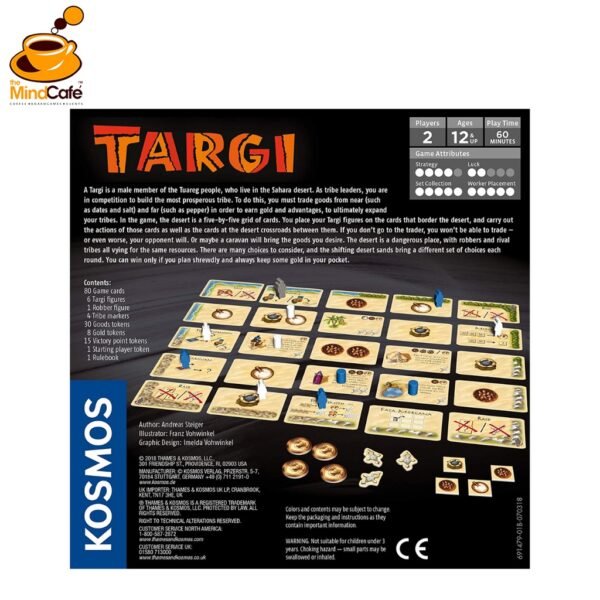
A Targi is a male member of the Tuareg people, who live in the Sahara desert. As tribe leader, you will be trading dates, salt, and pepper to obtain coveted gold coins and advantages. In the game, the desert is a five-by-five grid of cards. Position your Targi figures on the cards that border the desert. You carry out the actions of those cards as well as the cards at the crossroads between them. If you don’t go to the merchant, you won’t be able to trade — and even worse, your opponent will. Or maybe a caravan will bring the merchandise you desire. There are many choices to consider. But don’t wait too long, the desert is harsh and you might miss an opportunity to make a deal. In the next round, a completely different set of offerings will be on the table. The goods cards are the means to the end of getting highly desired tribe cards. These in turn bring advantages during the game and victory points at the end. You can win only if you plan shrewdly and always keep some gold in your pocket.
Game Genre: Strategy
No. of Players: 2 Players
Suitable for ages 12 and above
Game Duration: 60 min
Game Contents
80 cards
45 tribal cards
19 good cards
16 edge cards
8 gold coins
6 Targi figures
4 tribal markers
1 robber figure
30 goods tiles (ten each of dates, salt and pepper)
1 starting player tile (amulet)
15 victory point tokens (Silver Crosses, amounting to 6×1 cross, 5×3 cross, 4×5 cross)
Rules
How to Play
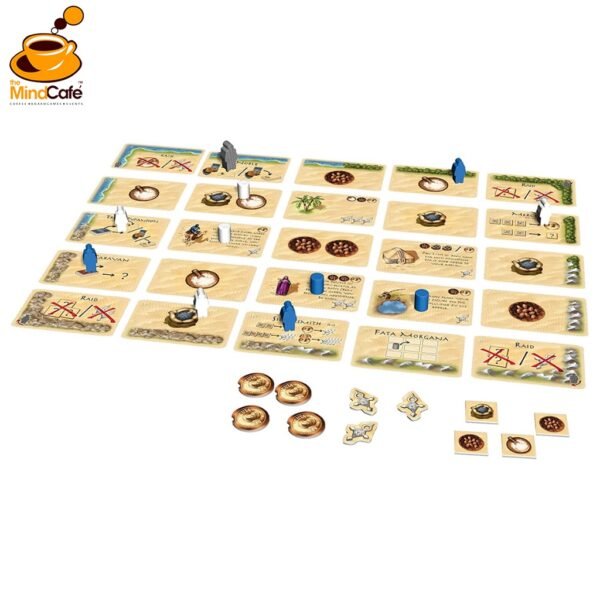
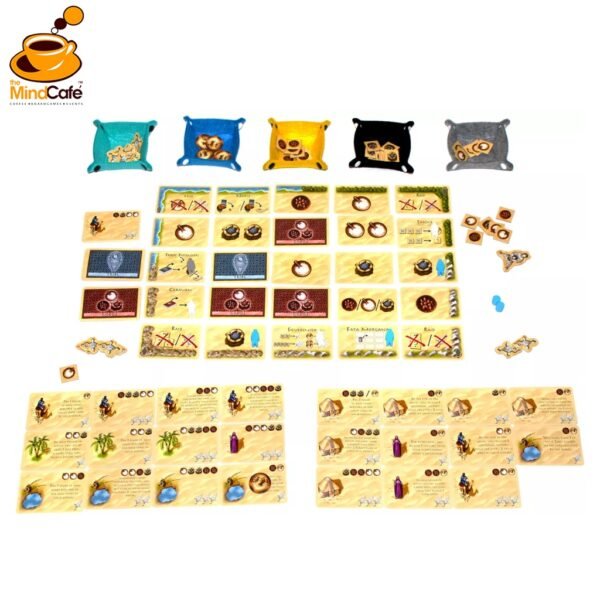
The board consists of a 5×5 grid: a border of 16 squares with printed action symbols and then 9 blank squares in the centre onto which cards are dealt. Meeples are placed one at a time on the spaces at the edges of the board (not including corner squares). You cannot place a meeple on a square the opponent has a meeple on already, nor on a square facing opponent’s meeple. Once all meeples are placed, players then execute the actions on the border squares the meeples are on and also take the cards from the centre that match the row and column of the border meeples.
The game is predominantly scored and won by playing tribal cards to your display. These give advantages during the game and victory points at the end. Usually cards are played (or discarded) immediately once drawn. A single card can be kept in hand but then requires a special action to play it (or to discard it to free the hand spot for another card). Each card has a cost in goods to play. Goods are obtained either from border spaces or from goods cards.
The display (for scoring) consists of 3 rows of 4 cards that are filled from left to right and cannot be moved once placed (barring some special cards). There is also a balance to be found between the victory point score on the cards themselves (1-3 VP per tribal card) and in the combinations per row (a full row of 4 identical card types gets you an additional 4 VP, and a full row of 4 distinct card types gets you 2 VP).
Targi
A Targi is a male member of the Tuareg people, who live in the Sahara desert. As tribe leader, you will be trading dates, salt, and pepper to obtain coveted gold coins and advantages. In the game, the desert is a five-by-five grid of cards. Position your Targi figures on the cards that border the desert. You carry out the actions of those cards as well as the cards at the crossroads between them. If you don’t go to the merchant, you won’t be able to trade — and even worse, your opponent will. Or maybe a caravan will bring the merchandise you desire. There are many choices to consider. But don’t wait too long, the desert is harsh and you might miss an opportunity to make a deal. In the next round, a completely different set of offerings will be on the table. The goods cards are the means to the end of getting highly desired tribe cards. These in turn bring advantages during the game and victory points at the end. You can win only if you plan shrewdly and always keep some gold in your pocket.
$37.90
Add To Cart


A Targi is a male member of the Tuareg people, who live in the Sahara desert. As tribe leader, you will be trading dates, salt, and pepper to obtain coveted gold coins and advantages. In the game, the desert is a five-by-five grid of cards. Position your Targi figures on the cards that border the desert. You carry out the actions of those cards as well as the cards at the crossroads between them. If you don’t go to the merchant, you won’t be able to trade — and even worse, your opponent will. Or maybe a caravan will bring the merchandise you desire. There are many choices to consider. But don’t wait too long, the desert is harsh and you might miss an opportunity to make a deal. In the next round, a completely different set of offerings will be on the table. The goods cards are the means to the end of getting highly desired tribe cards. These in turn bring advantages during the game and victory points at the end. You can win only if you plan shrewdly and always keep some gold in your pocket.
Game Genre: Strategy
No. of Players: 2 Players
Suitable for ages 12 and above
Game Duration: 60 min
Game Contents
80 cards
45 tribal cards
19 good cards
16 edge cards
8 gold coins
6 Targi figures
4 tribal markers
1 robber figure
30 goods tiles (ten each of dates, salt and pepper)
1 starting player tile (amulet)
15 victory point tokens (Silver Crosses, amounting to 6×1 cross, 5×3 cross, 4×5 cross)
Rules
How to Play
The board consists of a 5×5 grid: a border of 16 squares with printed action symbols and then 9 blank squares in the centre onto which cards are dealt. Meeples are placed one at a time on the spaces at the edges of the board (not including corner squares). You cannot place a meeple on a square the opponent has a meeple on already, nor on a square facing opponent’s meeple. Once all meeples are placed, players then execute the actions on the border squares the meeples are on and also take the cards from the centre that match the row and column of the border meeples.
The game is predominantly scored and won by playing tribal cards to your display. These give advantages during the game and victory points at the end. Usually cards are played (or discarded) immediately once drawn. A single card can be kept in hand but then requires a special action to play it (or to discard it to free the hand spot for another card). Each card has a cost in goods to play. Goods are obtained either from border spaces or from goods cards.
The display (for scoring) consists of 3 rows of 4 cards that are filled from left to right and cannot be moved once placed (barring some special cards). There is also a balance to be found between the victory point score on the cards themselves (1-3 VP per tribal card) and in the combinations per row (a full row of 4 identical card types gets you an additional 4 VP, and a full row of 4 distinct card types gets you 2 VP).
Related Products
Team 3 (Green)
Add To Cart

Flower Fairy
Add To Cart